- Among U.S. households with members who regularly use the Internet, 8 percent (six million households) downloaded at least one digital video file (10MB or larger) from a P2P service for free in the third quarter of 2006.
- Nearly 60 percent of video files downloaded from P2P sites were adult-film content, while 20 percent was TV show content and 5 percent was mainstream movie content.
Tuesday, December 26, 2006
P2P Digital Video Downloading Outpacing Legal Alternatives 5 to 1
The NPD Group posted a press release last week that confirms what everyone already knows - Adult-oriented content is the most popular genre among those who dowload video files via P2P. The research also indicates that:


Friday, December 15, 2006
New Radio Study Completed by FOMC
(Via press release) The Future of Music Coalition publicly released its report this week documenting the effects of radio station ownership consolidation on musicians and the public.
Data in the 116 page report shows that station ownership consolidation at the national and local levels has led to fewer choices in radio programming and harmed the listening public and those working in the music and media industries, including DJs, programmers and musicians.
Key points included in report:
* The top four radio station owners have almost half of the listeners and the top ten owners have almost two-thirds of listeners.
* The 'localness' of radio ownership – ownership by individuals living in the community -- has declined between 1975 and 2005 by almost one-third.
* Just fifteen formats make up three-quarters of all commercial programming. Moreover, radio formats with different names can overlap up to 80% in terms of the songs played on them.
* Niche musical formats like Classical, Jazz, Americana, Bluegrass, New Rock, and Folk, where they exist, are provided almost exclusively by smaller station groups.
* Across 155 markets, radio listenership has declined over the past fourteen years, a 22% drop since its peak in 1989. The consolidation allowed by the Telecom Act has failed to reverse
this trend."
Data in the 116 page report shows that station ownership consolidation at the national and local levels has led to fewer choices in radio programming and harmed the listening public and those working in the music and media industries, including DJs, programmers and musicians.
Key points included in report:
* The top four radio station owners have almost half of the listeners and the top ten owners have almost two-thirds of listeners.
* The 'localness' of radio ownership – ownership by individuals living in the community -- has declined between 1975 and 2005 by almost one-third.
* Just fifteen formats make up three-quarters of all commercial programming. Moreover, radio formats with different names can overlap up to 80% in terms of the songs played on them.
* Niche musical formats like Classical, Jazz, Americana, Bluegrass, New Rock, and Folk, where they exist, are provided almost exclusively by smaller station groups.
* Across 155 markets, radio listenership has declined over the past fourteen years, a 22% drop since its peak in 1989. The consolidation allowed by the Telecom Act has failed to reverse
this trend."
Tuesday, December 12, 2006
New Akamai Index Measures Real-Time Global Consumption of Online Music
(from press release) The Akamai Net Usage Index for Digital Music is the world's first and only daily Web traffic benchmark that tracks where and when digital music is being consumed on a global basis. Key to the relevance of the index - is the fact that Akamai is the delivery platform for many of the leading global digital music companies - giving it a unique view into the daily Web traffic of music streaming and music download websites.
Akamia's index tracks and benchmarks global Web usage patterns of visitors to more than 40 digital music websites, including music download sites, music destination sites, and live radio broadcast services, such as XM Satellite Radio, Clear Channel, Premiere Radio, MTV, Rediff.com and Napster, among others.
According to Brad Rinklin, vice president of Marketing, "The Net Usage Index for Digital Music data will help the industry by providing empirical data on consumer behavior and online music."
Data collected from the Index over the past three months shows key geographic patterns and insight into Web traffic trends associated with downloaded and streamed digital music:
The Index provides a global aggregate view of total visitors per minute, as well as a detailed view by continent, from a collection of digital music sites delivered by Akamai. All of the sites included in the index provide digital music streaming or downloads as their core business. Akamai's Net Usage Index offers businesses real-time information about the usage habits of visitors to their sites, and an industry benchmark to measure against. Anyone interested in data from the Index can view an aggregate, real-time view of Web traffic patterns online.
Akamia's index tracks and benchmarks global Web usage patterns of visitors to more than 40 digital music websites, including music download sites, music destination sites, and live radio broadcast services, such as XM Satellite Radio, Clear Channel, Premiere Radio, MTV, Rediff.com and Napster, among others.
According to Brad Rinklin, vice president of Marketing, "The Net Usage Index for Digital Music data will help the industry by providing empirical data on consumer behavior and online music."
Data collected from the Index over the past three months shows key geographic patterns and insight into Web traffic trends associated with downloaded and streamed digital music:
- North America, Asia, and Europe represent the bulk of visitor traffic to these sites
- Daily peak traffic worldwide is more than half a million visitors per minute
- Traffic peaks in North America and Europe tend to occur mid-week, while peaks in Asia and Australia come toward the end of the week
- Sunday is consistently the slowest day for visitors to these sites
The Index provides a global aggregate view of total visitors per minute, as well as a detailed view by continent, from a collection of digital music sites delivered by Akamai. All of the sites included in the index provide digital music streaming or downloads as their core business. Akamai's Net Usage Index offers businesses real-time information about the usage habits of visitors to their sites, and an industry benchmark to measure against. Anyone interested in data from the Index can view an aggregate, real-time view of Web traffic patterns online.
Tuesday, December 05, 2006
Superdistribution = ZUNE's Compensated Sharing + WEEDSHARE
With all the ZUNE-bashing lately, here's an interesting article from last Wednesday's Good Morning Silicon Valley, which talks about one of the most innovative and distinguishing business models out there called WEEDSHARE and Microsoft's recent desire to use it....no...copy it....umm...I mean share it :-) It's been updated twice since the original post (with some inquisitive patent comments at the end) and also picked up by Gizmodo.
The key point here is that the folks over at Weedshare are now sitting in the pole position to fully "exploit the intellectual property on which a core feature of a major Microsoft product is based."
The key point here is that the folks over at Weedshare are now sitting in the pole position to fully "exploit the intellectual property on which a core feature of a major Microsoft product is based."
Monday, November 27, 2006
Digital Music Market to reach $15 Billion by 2010
According to the latest research from iSuppli, The global market for digital recorded music, delivered both via broadband and over mobile-phone networks, is expected to grow by nearly six-fold during the period from 2005 to 2010.
Due to the rapid growth of these two segments, iSuppli believes the worldwide market for digital recorded music will reach $14.9 billion in revenue by 2010, expanding at a Compound Annual Growth Rate (CAGR) of 40.7 percent from $2.7 billion in 2005. Meanwhile, the market for physically distributed music, i.e. music CDs, will decline to $19.6 billion by 2010, down from $27.3 billion in 2005.
Major trends in digital music include:
Of these, the most important trend in digital music is the increasing competition between broadband music distribution and mobile network music distribution.
Due to the rapid growth of these two segments, iSuppli believes the worldwide market for digital recorded music will reach $14.9 billion in revenue by 2010, expanding at a Compound Annual Growth Rate (CAGR) of 40.7 percent from $2.7 billion in 2005. Meanwhile, the market for physically distributed music, i.e. music CDs, will decline to $19.6 billion by 2010, down from $27.3 billion in 2005.
Major trends in digital music include:
- The emerging competitive battle between mobile and broadband music services.-- Mobile/cellular music's generation of new revenue streams, as well as comparatively lower piracy risk and new forms of music derivatives.
- The strong expansion of broadband music revenue in North America, and the nascent growth in Europe and Japan.
- The vertical integration of the music playback devices, software and online stores, as more competitors mimic Apple's successful iTunes/iPod model.
- The rising number of mobile music track downloads and the increasing sales of music-enabled phones as a competitive threat to broadband music and standalone MP3 players. Music-enabled phones already out-ship MP3 players by a factor of more than 2 to 1.
Of these, the most important trend in digital music is the increasing competition between broadband music distribution and mobile network music distribution.
Monday, November 20, 2006
Rhapsody Releases White Paper
The folks over at Rhapsody have released a new 33 page PDF white paper which provides an overview of Rhapsody DNA, the music software platform that enables integration of the Rhapsody experience directly into hardware, software and the Web. Rhapsody DNA is an extension to the Rhapsody music service that provides the entire technology stack needed for a Rhapsody-branded consumer facing experience. Rhapsody DNA provides the consumer with secure, personalized end-to-end hardware, software and browser access to music and music assets. (The white paper also serves as an introduction to the Rhapsody DNA SDKs...)
Tuesday, October 24, 2006
DWA Publishes White Paper on P2P Copyright Issues
[via press release] "The Digital Watermarking Alliance (DWA), an international group of industry leading companies, recently announced a new white paper that discusses how digital watermarking can effectively address the copyright and content identification issues facing the peer-to-peer (P2P) and social networking communities.
The PDF white paper outlines how content owners can embed digital watermarks as content identifiers and digital media serial numbers into entertainment content to communicate the identity of copyrighted works. Because digital watermarks inherently survive the "ripping" process and format conversions, copyrighted songs, movies, TV or radio programming and images can be identified on P2P systems and online communities such as MySpace, YouTube, Google and Yahoo.
With technology that has been proven to be effective in billions of media objects, including music, TV, movies and digital images, P2P and online content sharing providers have the opportunity to work with content owners to deploy systems to detect digitally watermarked content as it is introduced into those systems and help ensure proper usage or compensation in accordance with rights."
The PDF white paper outlines how content owners can embed digital watermarks as content identifiers and digital media serial numbers into entertainment content to communicate the identity of copyrighted works. Because digital watermarks inherently survive the "ripping" process and format conversions, copyrighted songs, movies, TV or radio programming and images can be identified on P2P systems and online communities such as MySpace, YouTube, Google and Yahoo.
With technology that has been proven to be effective in billions of media objects, including music, TV, movies and digital images, P2P and online content sharing providers have the opportunity to work with content owners to deploy systems to detect digitally watermarked content as it is introduced into those systems and help ensure proper usage or compensation in accordance with rights."
Sunday, October 15, 2006
Nationwide Survey of 1,000 Digital Music Users
Below are the key findings of a recent report commissioned by www.soundflavor.com and conducted by Insight Express via the Internet from June 8-12, 2006. Consumers are clearly frustrated trying to find new music online, but apparently, help is on the way...the answer is SOUNDFLAVOR DJ (powered by the Soundflavor Music Recommendation Engine) which is based on more than six years of research spanning nearly every music genre. In a nutshell, the new music software helps iTunes users quickly create great playlists, rediscover the songs in their library, and discover new music based on songs that they already like. If it works as advertised, this could turn out to be a very valuable tool to have...
- The average digital music collection is substantial: nearly half (49%) of digital music users have more than 500 songs stored on their computer or laptop.
- Digital music users are not listening to all of the songs that they like: 64% note that they have a lot of music that they like but forget to play.
- Digital music users have trouble finding new music online: 41% say they have a hard time finding new music that they like when shopping online.
- Retailers are missing out on a key opportunity to sell music: 84% of respondents would purchase more music if they found more of it that they liked.
- Digital music users want help building playlists and finding new music: 67% said that they would use a service that helps them shop for new music and create playlists based on music that they like.
- The average digital music collection is substantial: nearly half (49%) of digital music users have more than 500 songs stored on their computer or laptop.
- Digital music users are not listening to all of the songs that they like: 64% note that they have a lot of music that they like but forget to play.
- Digital music users have trouble finding new music online: 41% say they have a hard time finding new music that they like when shopping online.
- Retailers are missing out on a key opportunity to sell music: 84% of respondents would purchase more music if they found more of it that they liked.
- Digital music users want help building playlists and finding new music: 67% said that they would use a service that helps them shop for new music and create playlists based on music that they like.
Monday, October 02, 2006
DVD Jon Fairplays Apple
The Apple DRM solution has been reserve-engineered by "DVD Jon" and he's apparently going to license the solution to other companies who want their digital products on iPods, beyond MP3 quality..."Instead of breaking the DRM (something he’s already done), Jon has replicated it, andwants to license the technology to companies that want their content (music,movies, whatever) to play on Apple devices. This may not be good news foriTunes the store, but it could make the iPod even more popular."
Saturday, September 30, 2006
ComScore Releases U.S. Video Metrix Rankings
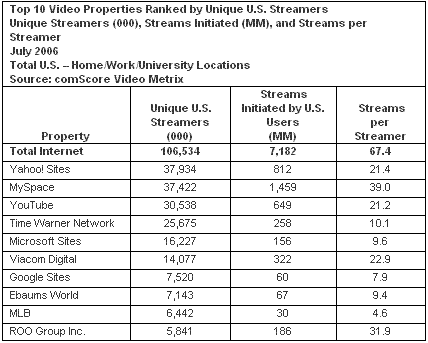 Video Metrix is the first and only service to track actual online streaming video behavior among U.S. Internet users, offering publishers and advertisers valuable insights into the emerging Internet video universe. According to the latest press release, Flash video content is now part of the monthly rankings for streaming video sites and as a result - Yahoo sites attract the most U.S. streamers while MySpace leads in number of streams among U.S. internet users.
comScore Video Metrix measures online video content served through all major media players, including: Flash, RealPlayer, Windows Media, QuickTime and DivX. (The service, which is based on streaming activity among U.S. Internet users, does not include measurement of digital rights management (DRM) content online, videos viewed through peer-to-peer (P2P) applications, or offline viewing of video content.)
Tuesday, September 26, 2006
The Future of the Internet - PART II
The Pew Internet Project announces the release of its second report on The Future of the Internet. (For the full report, please click HERE.) The report is built around respondents' responses to scenarios stretching to the year 2020 and hundreds of their written elaborations that address such things as the kinds of new social interactions that will occur when more "meetings" take place on screens; the changes that will occur in nation-states; the evolution of autonomous technology; and the proper ways to police the internet. According to the press release, a survey of internet leaders, activists, and analysts shows that a majority agree with predictions that by 2020:
o A low-cost global network will be thriving and creating new opportunities in a "flattening" world.
o Humans will remain in charge of technology, even as more activity is automated and "smart agents" proliferate. However, a significant 42% of survey respondents were pessimistic about humans' ability to control the technology in the future. This significant majority agreed that dangers and dependencies will grow beyond our ability to stay in charge of technology. This was one of the major surprises in the survey.
o Virtual reality will be compelling enough to enhance worker productivity and also spawn new addiction problems.
o Tech "refuseniks" will emerge as a cultural group characterized by their choice to live off the network. Some will do this as a benign way to limit information overload, while others will commit acts of violence and terror against technology-inspired change.
o People will wittingly and unwittingly disclose more about themselves, gaining some benefits in the process even as they lose some privacy.
o English will be a universal language of global communications, but other languages will not be displaced. Indeed, many felt other languages such as Mandarin, would grow in prominence.
o A low-cost global network will be thriving and creating new opportunities in a "flattening" world.
o Humans will remain in charge of technology, even as more activity is automated and "smart agents" proliferate. However, a significant 42% of survey respondents were pessimistic about humans' ability to control the technology in the future. This significant majority agreed that dangers and dependencies will grow beyond our ability to stay in charge of technology. This was one of the major surprises in the survey.
o Virtual reality will be compelling enough to enhance worker productivity and also spawn new addiction problems.
o Tech "refuseniks" will emerge as a cultural group characterized by their choice to live off the network. Some will do this as a benign way to limit information overload, while others will commit acts of violence and terror against technology-inspired change.
o People will wittingly and unwittingly disclose more about themselves, gaining some benefits in the process even as they lose some privacy.
o English will be a universal language of global communications, but other languages will not be displaced. Indeed, many felt other languages such as Mandarin, would grow in prominence.
Thursday, September 21, 2006
Beyond The Soundbytes - The MusicTank Report

Since its inception in 2003, MusicTank has earned its title as the UK music business network- a collaborative community that overrides traditional industry partitions in all genres. The network also hosts regular think tanks which bring hot topics into sharp focus and help pinpoint the opportunities created by disruptive technologies.
"In composing this first ever review of MusicTank activity, Peter Jenner has summed up of-the-moment Think Tank debates, from DRM usage to the emerging possibilities of future radio, and has also taken this opportunity to look beneath the immediate issues to unearth the fundamental and seismic changes which new technology and new consumer attitudes continue to affect within all areas of the business. "
The main findings of the report, in terms of where the industry is now, where it should be, and how it can get there, are summed up in the freely available Executive Summary available HERE.
Thursday, September 14, 2006
Apple's DRM Cracked Once Again!
Thanks to our friends over at the Wired Blog called the Listening Post, cracking Apples Fairplay DRM for the new iTunes 7 is pretty simple using version 2.3 of the application called QTFairUse6 created by the clever hackers inhabiting the pages of www.Hymn-Project.org. (The only drawback is that it removes the usability restrictions one song at a time and leaves you with a naked file in the AAC format - which doesn't work on every portable music player yet...)
(Correction: Only version 1.0 produced raw AAC files. Versions 2.0+ produce nicely playable .m4a files with all metadata intact.)
(Correction: Only version 1.0 produced raw AAC files. Versions 2.0+ produce nicely playable .m4a files with all metadata intact.)
Saturday, September 09, 2006
White Paper Evaluates DRM
PRESS RELEASE: Last week The Center for Democracy & Technology (CDT) released a document designed to help promote a greater public understanding of the choices and tradeoffs associated with products and services that include Digital Rights Management (DRM) technology.
An electronic PDF copy of the paper is available at:
http://www.cdt.org/copyright/20060907drm.pdf
A handy reference sheet is available at:
http://www.cdt.org/copyright/20060907drm-metrics.php.
"The rapid emergence of DRM technology has sparked a serious policy debate between copyright owners, who say the technology is essential to protecting their works, and critics who warn that many DRM technologies threaten to undermine consumers' rights to use digital media. But as that debate rages, DRM products continue to enter the marketplace, leaving consumers to decide what tradeoffs they're willing to make when buying electronic media.
The paper tackles the complicated subject of copyright protection technology, offering a clear set of metrics for consumers and product reviewers to consider when evaluating DRM-protected devices and services. The goal of the paper is to educate users about what questions to ask to determine how various DRM applications may affect their ability to use movies, music, games and other media."
An electronic PDF copy of the paper is available at:
http://www.cdt.org/copyright/20060907drm.pdf
A handy reference sheet is available at:
http://www.cdt.org/copyright/20060907drm-metrics.php.
"The rapid emergence of DRM technology has sparked a serious policy debate between copyright owners, who say the technology is essential to protecting their works, and critics who warn that many DRM technologies threaten to undermine consumers' rights to use digital media. But as that debate rages, DRM products continue to enter the marketplace, leaving consumers to decide what tradeoffs they're willing to make when buying electronic media.
The paper tackles the complicated subject of copyright protection technology, offering a clear set of metrics for consumers and product reviewers to consider when evaluating DRM-protected devices and services. The goal of the paper is to educate users about what questions to ask to determine how various DRM applications may affect their ability to use movies, music, games and other media."
Thursday, September 07, 2006
The Digital Learning Challenge
 Obstacles to Educational Uses of Copyrighted Material in the Digital Age - Click HERE to read the White Paper online, which reports on a year-long study by the Berkman Center for Internet and Society, funded by a grant from the Andrew W. Mellon Foundation. The study explores whether innovative educational uses of digital technology – everything from DVDs in the classroom to digital music libraries to online resources such as Wikipedia -- are hampered by copyright restrictions.
The foundational paper examines the relationship between copyright law and education. In particular, exploring whether innovative educational uses of digital technology are hampered by the restrictions of copyright. They found that provisions of copyright law concerning the educational use of copyrighted material, as well as the business and institutional structures shaped by that law, are among the most important obstacles to realizing the potential of digital technology in education. The paper builds on four detailed case studies of initiatives that have encountered such obstacles. Each of these initiatives is moving forward, but only by fighting against a copyright-related system that instead should be helping educators accomplish their goals...
While the primary task of the paper was to identify these obstacles, the paper concludes with some discussion of paths toward reform that might improve the situation. It suggests that certain types of legal reform, technological improvements in the rights clearance process, educator agreement on best practices, and increased use of open access distribution would help overcome the obstacles identified.It's available in HTML and PDF. You can also listen to an interview with McGeveran about the paper at AudioBerkman.
Subscribe to:
Posts (Atom)