Monday, November 27, 2006

Digital Music Market to reach $15 Billion by 2010

According to the latest research from iSuppli, The global market for digital recorded music, delivered both via broadband and over mobile-phone networks, is expected to grow by nearly six-fold during the period from 2005 to 2010.

Due to the rapid growth of these two segments, iSuppli believes the worldwide market for digital recorded music will reach $14.9 billion in revenue by 2010, expanding at a Compound Annual Growth Rate (CAGR) of 40.7 percent from $2.7 billion in 2005. Meanwhile, the market for physically distributed music, i.e. music CDs, will decline to $19.6 billion by 2010, down from $27.3 billion in 2005.

Major trends in digital music include:

  • The emerging competitive battle between mobile and broadband music services.-- Mobile/cellular music's generation of new revenue streams, as well as comparatively lower piracy risk and new forms of music derivatives.
  • The strong expansion of broadband music revenue in North America, and the nascent growth in Europe and Japan.
  • The vertical integration of the music playback devices, software and online stores, as more competitors mimic Apple's successful iTunes/iPod model.
  • The rising number of mobile music track downloads and the increasing sales of music-enabled phones as a competitive threat to broadband music and standalone MP3 players. Music-enabled phones already out-ship MP3 players by a factor of more than 2 to 1.

Of these, the most important trend in digital music is the increasing competition between broadband music distribution and mobile network music distribution.

Monday, November 20, 2006

Rhapsody Releases White Paper

The folks over at Rhapsody have released a new 33 page PDF white paper which provides an overview of Rhapsody DNA, the music software platform that enables integration of the Rhapsody experience directly into hardware, software and the Web. Rhapsody DNA is an extension to the Rhapsody music service that provides the entire technology stack needed for a Rhapsody-branded consumer facing experience. Rhapsody DNA provides the consumer with secure, personalized end-to-end hardware, software and browser access to music and music assets. (The white paper also serves as an introduction to the Rhapsody DNA SDKs...)

Tuesday, October 24, 2006

DWA Publishes White Paper on P2P Copyright Issues

[via press release] "The Digital Watermarking Alliance (DWA), an international group of industry leading companies, recently announced a new white paper that discusses how digital watermarking can effectively address the copyright and content identification issues facing the peer-to-peer (P2P) and social networking communities.

The PDF white paper outlines how content owners can embed digital watermarks as content identifiers and digital media serial numbers into entertainment content to communicate the identity of copyrighted works. Because digital watermarks inherently survive the "ripping" process and format conversions, copyrighted songs, movies, TV or radio programming and images can be identified on P2P systems and online communities such as MySpace, YouTube, Google and Yahoo.

With technology that has been proven to be effective in billions of media objects, including music, TV, movies and digital images, P2P and online content sharing providers have the opportunity to work with content owners to deploy systems to detect digitally watermarked content as it is introduced into those systems and help ensure proper usage or compensation in accordance with rights."

Sunday, October 15, 2006

Nationwide Survey of 1,000 Digital Music Users

Below are the key findings of a recent report commissioned by www.soundflavor.com and conducted by Insight Express via the Internet from June 8-12, 2006. Consumers are clearly frustrated trying to find new music online, but apparently, help is on the way...the answer is SOUNDFLAVOR DJ (powered by the Soundflavor Music Recommendation Engine) which is based on more than six years of research spanning nearly every music genre. In a nutshell, the new music software helps iTunes users quickly create great playlists, rediscover the songs in their library, and discover new music based on songs that they already like. If it works as advertised, this could turn out to be a very valuable tool to have...

- The average digital music collection is substantial: nearly half (49%) of digital music users have more than 500 songs stored on their computer or laptop.

- Digital music users are not listening to all of the songs that they like: 64% note that they have a lot of music that they like but forget to play.

- Digital music users have trouble finding new music online: 41% say they have a hard time finding new music that they like when shopping online.

- Retailers are missing out on a key opportunity to sell music: 84% of respondents would purchase more music if they found more of it that they liked.

- Digital music users want help building playlists and finding new music: 67% said that they would use a service that helps them shop for new music and create playlists based on music that they like.

Monday, October 02, 2006

DVD Jon Fairplays Apple

The Apple DRM solution has been reserve-engineered by "DVD Jon" and he's apparently going to license the solution to other companies who want their digital products on iPods, beyond MP3 quality..."Instead of breaking the DRM (something he’s already done), Jon has replicated it, andwants to license the technology to companies that want their content (music,movies, whatever) to play on Apple devices. This may not be good news foriTunes the store, but it could make the iPod even more popular."

Saturday, September 30, 2006

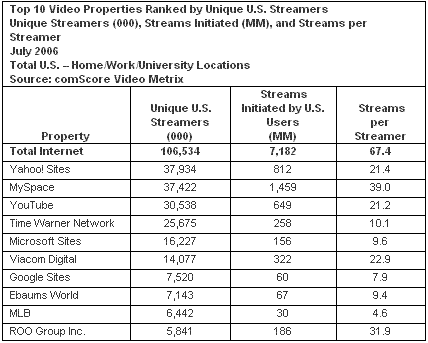
ComScore Releases U.S. Video Metrix Rankings

Video Metrix is the first and only service to track actual online streaming video behavior among U.S. Internet users, offering publishers and advertisers valuable insights into the emerging Internet video universe. According to the latest press release, Flash video content is now part of the monthly rankings for streaming video sites and as a result - Yahoo sites attract the most U.S. streamers while MySpace leads in number of streams among U.S. internet users.

comScore Video Metrix measures online video content served through all major media players, including: Flash, RealPlayer, Windows Media, QuickTime and DivX. (The service, which is based on streaming activity among U.S. Internet users, does not include measurement of digital rights management (DRM) content online, videos viewed through peer-to-peer (P2P) applications, or offline viewing of video content.)

Tuesday, September 26, 2006

The Future of the Internet - PART II

The Pew Internet Project announces the release of its second report on The Future of the Internet. (For the full report, please click HERE.) The report is built around respondents' responses to scenarios stretching to the year 2020 and hundreds of their written elaborations that address such things as the kinds of new social interactions that will occur when more "meetings" take place on screens; the changes that will occur in nation-states; the evolution of autonomous technology; and the proper ways to police the internet. According to the press release, a survey of internet leaders, activists, and analysts shows that a majority agree with predictions that by 2020:

o A low-cost global network will be thriving and creating new opportunities in a "flattening" world.

o Humans will remain in charge of technology, even as more activity is automated and "smart agents" proliferate. However, a significant 42% of survey respondents were pessimistic about humans' ability to control the technology in the future. This significant majority agreed that dangers and dependencies will grow beyond our ability to stay in charge of technology. This was one of the major surprises in the survey.

o Virtual reality will be compelling enough to enhance worker productivity and also spawn new addiction problems.

o Tech "refuseniks" will emerge as a cultural group characterized by their choice to live off the network. Some will do this as a benign way to limit information overload, while others will commit acts of violence and terror against technology-inspired change.

o People will wittingly and unwittingly disclose more about themselves, gaining some benefits in the process even as they lose some privacy.

o English will be a universal language of global communications, but other languages will not be displaced. Indeed, many felt other languages such as Mandarin, would grow in prominence.

Thursday, September 21, 2006

Beyond The Soundbytes - The MusicTank Report


Since its inception in 2003, MusicTank has earned its title as the UK music business network- a collaborative community that overrides traditional industry partitions in all genres. The network also hosts regular think tanks which bring hot topics into sharp focus and help pinpoint the opportunities created by disruptive technologies.

"In composing this first ever review of MusicTank activity, Peter Jenner has summed up of-the-moment Think Tank debates, from DRM usage to the emerging possibilities of future radio, and has also taken this opportunity to look beneath the immediate issues to unearth the fundamental and seismic changes which new technology and new consumer attitudes continue to affect within all areas of the business. "

The main findings of the report, in terms of where the industry is now, where it should be, and how it can get there, are summed up in the freely available Executive Summary available HERE.

Thursday, September 14, 2006

Apple's DRM Cracked Once Again!

Thanks to our friends over at the Wired Blog called the Listening Post, cracking Apples Fairplay DRM for the new iTunes 7 is pretty simple using version 2.3 of the application called QTFairUse6 created by the clever hackers inhabiting the pages of www.Hymn-Project.org. (The only drawback is that it removes the usability restrictions one song at a time and leaves you with a naked file in the AAC format - which doesn't work on every portable music player yet...)

(Correction: Only version 1.0 produced raw AAC files. Versions 2.0+ produce nicely playable .m4a files with all metadata intact.)

Saturday, September 09, 2006

White Paper Evaluates DRM

PRESS RELEASE: Last week The Center for Democracy & Technology (CDT) released a document designed to help promote a greater public understanding of the choices and tradeoffs associated with products and services that include Digital Rights Management (DRM) technology.

An electronic PDF copy of the paper is available at:
http://www.cdt.org/copyright/20060907drm.pdf

A handy reference sheet is available at:
http://www.cdt.org/copyright/20060907drm-metrics.php.

"The rapid emergence of DRM technology has sparked a serious policy debate between copyright owners, who say the technology is essential to protecting their works, and critics who warn that many DRM technologies threaten to undermine consumers' rights to use digital media. But as that debate rages, DRM products continue to enter the marketplace, leaving consumers to decide what tradeoffs they're willing to make when buying electronic media.

The paper tackles the complicated subject of copyright protection technology, offering a clear set of metrics for consumers and product reviewers to consider when evaluating DRM-protected devices and services. The goal of the paper is to educate users about what questions to ask to determine how various DRM applications may affect their ability to use movies, music, games and other media."

Thursday, September 07, 2006

The Digital Learning Challenge

Obstacles to Educational Uses of Copyrighted Material in the Digital Age - Click HERE to read the White Paper online, which reports on a year-long study by the Berkman Center for Internet and Society, funded by a grant from the Andrew W. Mellon Foundation. The study explores whether innovative educational uses of digital technology – everything from DVDs in the classroom to digital music libraries to online resources such as Wikipedia -- are hampered by copyright restrictions.

The foundational paper examines the relationship between copyright law and education. In particular, exploring whether innovative educational uses of digital technology are hampered by the restrictions of copyright. They found that provisions of copyright law concerning the educational use of copyrighted material, as well as the business and institutional structures shaped by that law, are among the most important obstacles to realizing the potential of digital technology in education. The paper builds on four detailed case studies of initiatives that have encountered such obstacles. Each of these initiatives is moving forward, but only by fighting against a copyright-related system that instead should be helping educators accomplish their goals...

While the primary task of the paper was to identify these obstacles, the paper concludes with some discussion of paths toward reform that might improve the situation. It suggests that certain types of legal reform, technological improvements in the rights clearance process, educator agreement on best practices, and increased use of open access distribution would help overcome the obstacles identified.It's available in HTML and PDF. You can also listen to an interview with McGeveran about the paper at AudioBerkman.

Saturday, August 19, 2006

NARM 2006 Video - "Top 10 Reasons Indies Do It Better"

Here's a 6 minute VIDEO of the American Association of Music (a2im) President, Don Rose and Membership Director, Rob Weitzner, discussing the Top 10 Reasons Indies Do It Better. After only 1 year in existence, the a2im has over 125 member labels and 60 associate members. (sorry in advance for the room echo!)

The "Indie Show" panel was sponsored by San Diego-based Royaltyshare, who officially announced at NARM a new digital royalty infrastructure solution and service for record labels and music distributors to track mechanical and artist royalties for sound recordings. RoyaltyShare will provide indies Web-based services (with no upfront or set-up fees) to clients, who are then billed 1.5% of all royalty revenues from sales of content on services like iTunes, Rhapsody and eMusic. Called Digital Advantage, the management system allows labels and distributors to easily aggregate, monitor and interpret a broad array of digital sales receipts.

NARM - Day 3 CONT'D

The 2nd research presentation of the day was presented by Chris Muratore and Rob Sisco, from Nielsen SoundScan. It was reported that Nielsen is currently the only pan-american music tracking service and they are now seeing the trending in Europe. One example of this is that mobile full-track downloads are outpacing PC downloads across the pond...(It's worth noting that SoundScan tracks over 300 labels and that all the online digital music services report sales totals every week...) While it's easy to get excited with all the reported growth in digital, it's extremely important to keep in mind that it's still only 6% of the market. (Maybe someday we can also factor in streams and mobile sales to get a clearer picture, eh...?) Listed below are some of the highlights.

- The industry just experienced a sharp decline - 2nd lowest week since 1994 - with only 8.9 million sales. (2006 has had 36,866 new album releases with 13,210 being digital only.)

- Although CD album sales were down almost 8%, overall music purchases (which includes albums, singles and digital tracks) exceeded 1 billion for the first time ever! In other words, even though CD's aren't flying off the shelves, there was a 23% increase in overall paid music consumption - which is great news for the industry.

- Mass merchant channels (i.e., Best Buy, Target) continue to grow, hitting a 40% marketshare for the very first time.

- Internet album sales were up 11% over 2004 and digital album sales had 200% growth in 2005. (2006's digital album sales are up 123% over last year.)

- For you trivia lovers, the Black Eyed Peas have sold the most digital tracks of all time of any band at 6.3 million. (Eminem is 2nd at 5.8 mil and Green Day is third at 5.5. mil)

NARM - Day 3

Friday's NARM/NPD part III research results were delivered by Russ Crupnick from The NPD Group. (NARM promised to send the almost-completed report to its members soon, but if you were smart enough to have attended, NPD also gave out free USB stick drives with Parts I&II on them.) It's important to note that NPD's research did not look at the impact of ringtones.)

- There are just over 150 million music shoppers in the U.S. and the average revenue per person over age 13 is $8.85. (19% of music buyers walk in into the store and only buy 1 item, but the existence of bundles do help purchasing decisions.)

- Music consumption is up 12% as physical sales slide 8%. (Apple held 76% of the market in June 2006 for downoads)

- Consumers are not becoming less loyal - the problem is that there's too many choices and they're being overstimlated. The result is that there's a lot of competition for their time and money and the channels for music buying are becoming blurry.

- For the lighter browsing segments new demand has to be created while they sit on the couch and awareness levels have to be built before they even get into the car.

- Consumers spend nearly a day per week listening to music (89% of music buyers are on the web and spend 21 hours a week online)

- People are actually consuming more music than ever. Physical sales are off but music consumption is up 12% - mostly through unpaid means of acquisition. Some good news from the research (which I personally find hard to believe) indicates that consumers believe that music is every bit as good a value as DVD's.

- One new trend is that people are getting conditioned to do one-stop-shopping (i.e., Super Walmart, Super Target) and tend to get all their errands done at less stores.

- Nearly 9 out of 10 physical music buyers are unaware of kiosks, which could be better utilized to offer deeper and out-of-print catalogue choices.

- Consumers are willing to pay for more actual content (i.e. DVD) but the expectation is more value for same price. The avg. DVD price is $15.98.

Sunday, August 06, 2006

NARM Show DAY 2

Day two of NARM's annual meeting started off with a brief presentation by president Jim Donio, where he gave an insightful overview of the industry and shared several ways in which NARM is trying to help its members. For example, the organization's Media On Demand task force has evolved into a broader Digital Entertainment Council to deal with the wider range of challenges facing the industry. Key advocacy priorities on the horizon are: music licensing reform (i.e., SIRA), Anti-piracy, improved ratings & labeling as well as more emphasis on artist development. Donio also announced that next year's Spring NARM meeting will be held in Chicago from April 29 - May 2nd.

Last week's sales numbers were not pretty. According to Nielsen SoundScan figures, physical album sales were the lowest they've been since January 1994. Although physical CD sales continue to decline when compared to last year's numbers, the simple fact is: America's passion for music remains. With the plethora of entertainment choices brought on by new technology, this basic passion has evolved though and retailers need to continually adapt or get out of the game. [Too many choices = situational shopping.] Any business that's going to be successful needs to have parallel paths.

One of the main challenges the industry faces is how to get the consumer 'off of the couch' with so many entertainment choices. To effectively meet this challenge, retailers need a much more sophisticated understanding of their shopper base. In addition, NARM's members need to work tirelessly with the distribution companies to raise awareness of new product releases, especially for new media formats.

Another industry-wide problem is that the configuration of certain CD/DVD sales data may be misleading when you actually sit down and try to analyze certain data trends. For example, are CD's that are included with DVD box sets counted as CD sales or a DVD sale, etc...? With all the numbers flying around this year's conference, it's interesting to note that ringbacks, subscriptions, kiosks and streaming sales are not normally factored into the music industry's overall sales figures. This is due to the fact that Soundscan only reports on album sales and digital song downloads. However, from a macro level when these additional sources are factored in, there are many new types of revenue streams that help paint a much brighter picture for the health of the industry.

The "State of Music Retail Discussion" consisted of several big box retailers including Gary Arnold, Sr. VP of Entertainment from Best Buy Enterprise and Darrell Tucker, VP Merchandising, from Target Stores. The general mood was positive - although Arnold thinks that the overall retail industry is "choppy", especially when considering the fact that Best Buy made more money last year selling MP3 players than CD's. John Marmaduke, CEO of Hastings Entertainment, stated that "CD burning and increased competition from video games are the driving forces behind the lagging sales and digital by itself - is not a bad thing...We've got to figure out how to make a living selling the long tail artists....Formulaic promotions may help (i.e., focusing on the 80's slice of the catalogue)."

During the same panel it was also mentioned that reversing the multi-year downward sales trend can possibly be achieved through the practice and execution of flawless category management and product mix modifications. In other words, if the retail experience is designed and delivered effectively - consumers will still patronize retail stores. Case in point: people don't necessarily go to Starbucks just for the coffee...it's for the EXPERIENCE. However, changing the retail experience requires a lot of effort - which will no doubt result in some heavy experimentation and failures. During this transitional phase, one of the keys to success will be to stay flexible.

According to Target's Tucker, "the digital format was chosen by the consumer in a non-retail friendly way, so we're going through a cultural shift as a result and we're now only at the tip of the iceberg." Digital IS the revolution and no one company or entity will own the music business in totality.

Today's youth are hungry for content and knowledge about it. The fact is, kids aren't hanging out anymore at listening stations in the stores. With hundreds of new releases every year, how is the consumer to know or choose what to buy? Any customer assistance in this area would be helpful and welcomed. Thanks to p2p and the internet though, the average consumer now knows more than most music store clerks. Best Buy is aware of this problem and has over 7,000 employees tasked specifically to media. Basically, they're trying to create a community inside the company where these media employees can share and inspire one another.According to Maramaduke, "The music industry needs to figure out that you can't continue to do business the old way and wait to release all of your best titles in the 4th quarter. Music can't effectively compete with video and video game sales because they own this part of the fiscal year because they spend over a billion dollars in advertising...Unfortunately, the music industry isn't based on research - It's based on habit."

The morning session ended with a keynote by Chris Sacca, Google's Head of Special Initiatives. Sacca said that "the big opportunity in digital music is in developing the ecosystem: one that allows consumers to move content from the home to the car and between devices with ease." I couldn't agree more. Google appears to have reconsidered rumours of it's desire to make a retail play in music and is putting the brakes on music and other areas of digital entertainment, which I'm sure was a sigh of relief for NARM members.

The a2im's acting presdient Don Rose hosted the "Indie Show" skit in the afternoon which was tailored after David Letterman's show. Licensing opportunities in new arenas were discussed and the humorous approach was quite refreshing. Attendees heard from Bob French, Mix & Burn, Adam Sexton, Groove Mobile and Amaechi Uzoigwe, from World's Fair.To end the day in style, the Sony/BGM cocktail party was held on a massive 60 foot sailboat moored in the Gaylord's salt water lagoon and was as tropical as you could get without the humidity. (The entire resort is housed under a gigantic glass dome resulting in a theme-park- like atrium atmosphere with no insects and cool air conditioning everywhere you go).

Also noteworthy for NARM's history book, Sprint was onsite mobile-casting some of the nightly performances directly onto its Power Vision network. Loyal fans who couldn't make the show could tune in to a channel on Sprint TV and watch the performance stream live on their cell phones, which is an interesting new broadcast channel and delivery method...